
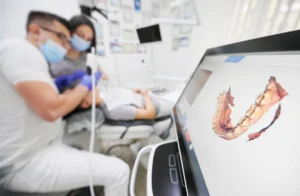
Digital dentistry has moved well beyond being a new technology. For many practices, it has become the foundation of how restorative cases are planned, communicated, and produced. At the center of this shift is the intraoral scanner. The scan creates a 3D dataset that becomes the reference model for design and manufacturing. Instead of sending a physical impression to the lab, clinicians now send a digital file that technicians can immediately evaluate and begin designing from.
One of the most interesting aspects of digital impressions is how accuracy is measured. In digital metrology, accuracy is typically described as the combination of trueness and precision. Trueness refers to how closely the scan matches the real geometry of the teeth. Precision refers to how consistently the scanner can reproduce that result across repeated scans. Understanding this distinction helps explain why scanning technique and protocol can have a significant effect on restorative outcomes.
For many common restorative indications such as crowns and short span bridges, digital impressions perform very well. Recent reviews comparing digital and conventional impressions show similar results for marginal and internal fit in many fixed prosthodontic cases. However, full arch restorations can still be more challenging with digital scanning, particularly when long span accuracy and soft tissue management are involved. In these situations, careful scanning strategy and verification are especially important.
Another area where digital workflows continue to evolve is occlusion. Many CAD systems now include virtual articulators that allow technicians to simulate occlusion during the design phase. While this can be very helpful, dynamic occlusion capture is still limited by the records that are provided. When cases involve complex occlusal relationships, additional records or verification steps can still be valuable.
Beyond the clinical side, digital workflows also change how dentists and laboratories communicate. Digital files allow technicians to review cases quickly, identify potential design issues, and collaborate with the doctor before fabrication begins. Photos, bite records, and written instructions become even more important because they help the lab understand the clinical goals behind the case.
Practical considerations for digital cases
- Focus on verification rather than speed when scanning. Confirm margin visibility and interproximal capture before dismissing the patient.
- Establish a consistent scanning protocol within the practice to improve repeatability.
- Be cautious with full arch cases and long span restorations where scan accuracy can vary.
- Provide clear photos and clinical notes to support esthetic and functional decisions.
Digital collaboration with the laboratory
A digital workflow is only as predictable as the communication behind it. At Valley Dental Arts, digital cases are reviewed by experienced technicians who work closely with clinicians to evaluate scans, discuss restorative goals, and assist with design planning when needed. For complex implant or full arch cases, early collaboration can often help identify potential challenges before fabrication begins.
Digital technology continues to improve how restorative dentistry is delivered. When strong clinical records are combined with thoughtful laboratory collaboration, digital workflows can provide a level of efficiency and precision that was difficult to achieve only a few years ago.
This article is for informational purposes only and does not constitute clinical advice. All diagnosis and treatment decisions remain the responsibility of the treating dentist.